
How to store leather bags

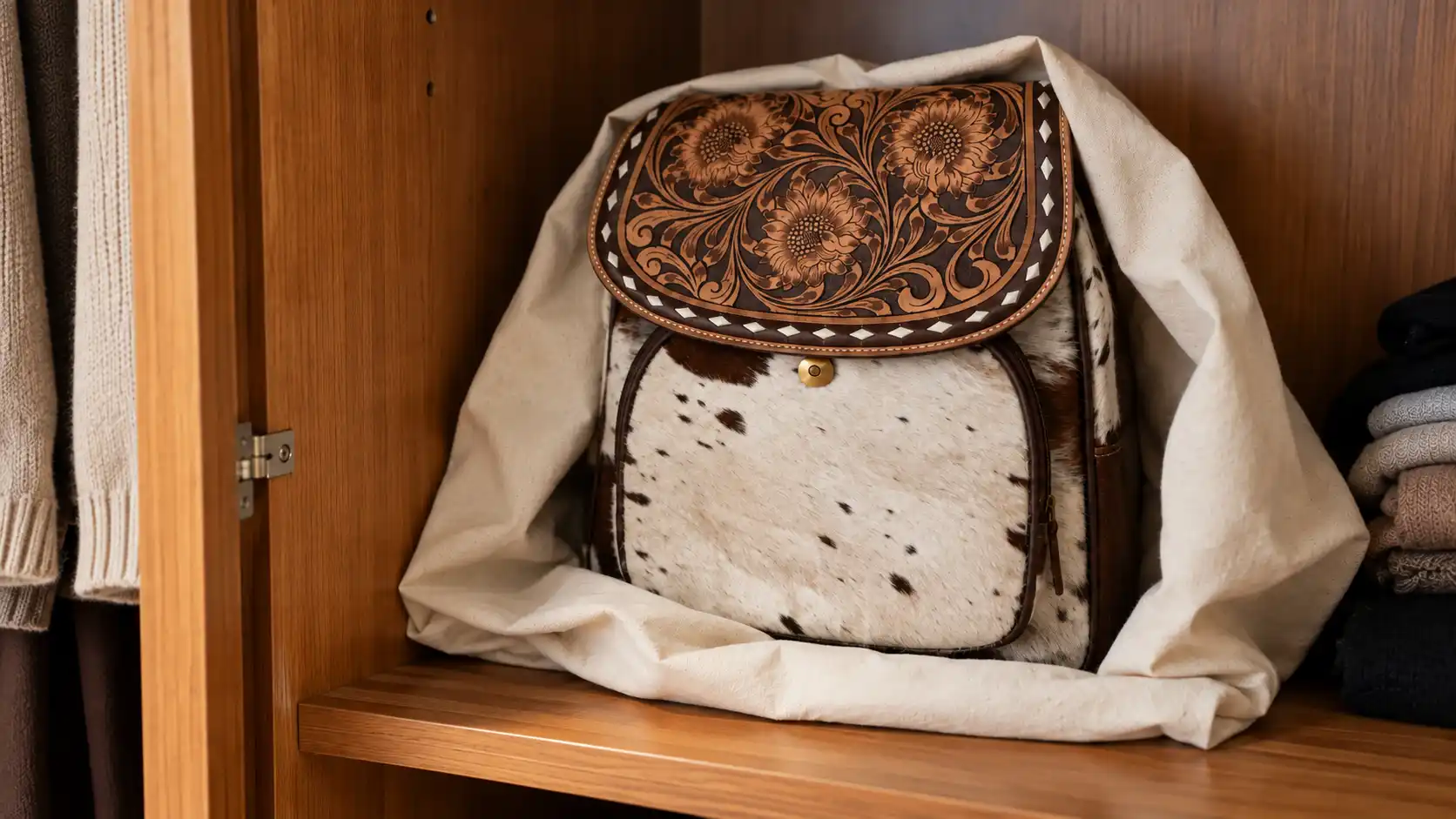
Short answer: To store a leather bag, empty it, brush off the dust and let it dry fully. Stuff it lightly with acid-free tissue, cover it with a breathable cotton dust bag, and stand it upright on a cool, dry shelf away from sunlight, heat and other bags.
Most advice on how to store a leather bag stops at “use a dust bag”. That helps, but the bigger risks are damp, heat, pressure and a bag left folded at the back of a cupboard for months. Conservators have published detailed guidance on all of it, and we’ve linked to it throughout so you can see where each number comes from.
Aesthec is a London-based handcrafted leather goods brand making bags, belts and wallets from full-grain leather. Many of our bags carry hand-carved floral panels, and each piece comes out slightly different, so we treat storage as part of looking after the craftsmanship.
How to store a leather bag, step by step
1. Empty the bag completely
Check every pocket. Pens, receipts and make-up can leave marks if they sit against leather for weeks, and an empty bag is easier to inspect. Turn it upside down once and give it a gentle shake to clear crumbs.
2. Brush off dust and dirt
Use a dry cloth or a soft brush. On carved areas, brush lightly so you don’t push grit into the grooves. Keep household cleaners, anything containing alcohol and abrasive pads away from the leather. Our own care guidance says the same for our hair-on cowhide pieces.
3. Let it dry fully before it goes away
This is the step people skip. If the bag has been rained on or kept somewhere humid, leave it to dry naturally at room temperature. A radiator or hairdryer dries the surface fast, but heat can dry out the leather itself. The Canadian Conservation Institute (CCI) warns that locally raised temperatures, such as a spot near a radiator, speed up deterioration.
4. Condition only if it needs it
Storage is not the moment for a heavy coat of conditioner. Museum conservators now avoid heavy dressings, because the CCI notes that too much applied oil can stiffen and darken leather over time. If your bag feels dry, use a conditioner made for that type of leather, follow the maker’s instructions and start with a very small amount. On hand-tooled panels, excess product can pool in the carved grooves and blur the detail, so we recommend a little, applied gently.
5. Give it support so it keeps its shape
A soft bag left empty will slump and crease along the same folds. Fill it lightly with acid-free tissue or clean cotton cloth, enough to hold the shape without pushing on the seams. The CCI recommends tissue that is unbuffered as well as acid-free, because buffered paper is alkaline and can harm leather, so check the packet.
Skip newspaper. The CCI lists newsprint among the materials to keep away from leather, and aunts & uncles warns that the ink can rub off. One maker that does use it, Tsuchiya Kaban, wraps the newspaper in towels first so the ink never touches the lining. Plain tissue is simpler.
Look at the fittings too. The CCI says copper and brass can leave waxy green corrosion where they touch leather, and suggests a thin sheet of polyethylene or Mylar between metal and leather. The Bridge takes a simpler route and wraps buckles and clasps in tissue.
6. Cover it with something that breathes
A cotton dust bag keeps off dust and light while letting air move. If you’ve lost the one that came with the bag, a clean white cotton pillowcase is a good substitute. Avoid sealed plastic. Museums & Galleries NSW advises that storage containers should not be airtight, and some plastic coatings can turn sticky and damage the leather. Our own guidance is to let the leather breathe.
7. Choose a stable spot
Pick a shelf with some space around the bag rather than a crowded corner. The sections below cover the conditions to aim for.
Upright, flat or hanging: how to store each type of bag
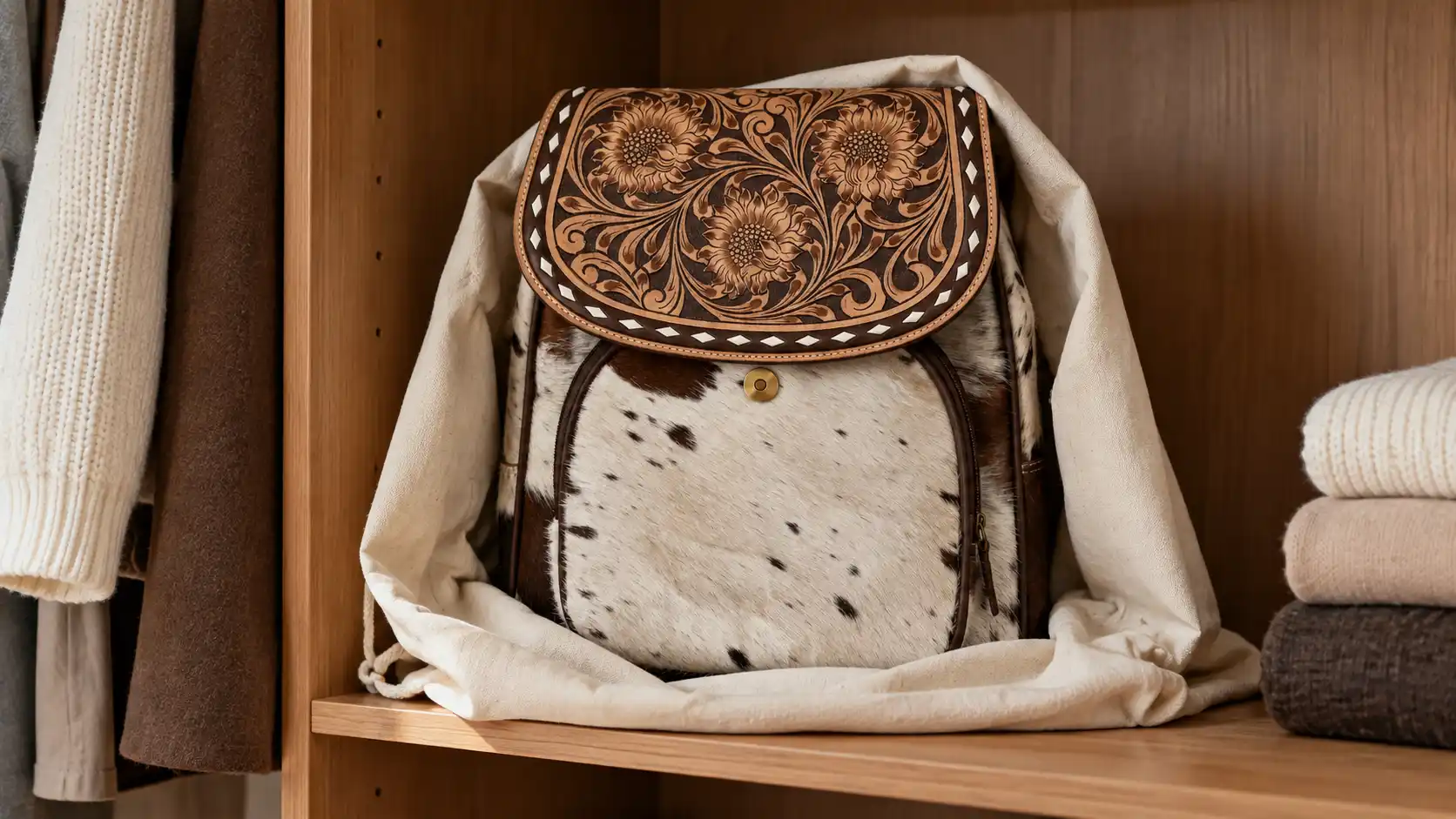
Aesthec’s own guidance is to stand bags upright when they’re not in use. That suits most structured bags and backpacks. Softer designs vary, so here is how we’d handle each type.
| Bag type | Best position | Inside | Straps and zips |
|---|---|---|---|
| Structured bag | Upright on a shelf | Light acid-free tissue to hold the shape | Close zips, buckles only halfway, strap tucked inside |
| Soft or slouchy bag | Upright if it holds its shape when stuffed, otherwise lying flat on its back | A little more tissue to stop slumping | Close zips, tuck the strap in, never fold the bag over itself |
| Leather backpack | Upright | Tissue in the main compartment | Loosen and tuck the straps, close zips |
| Hand-tooled bag | Upright, with nothing resting against the carved panel | Light tissue only | Keep straps clear of the carving |
Lying flat for soft bags follows the advice of one bag retailer, which stores sturdy bags upright and soft bags flat. Whichever you choose, don’t hang a bag by its handles. The weight compromises the structure over time, and the handles stretch out of shape. If you do store bags lying down, don’t stack them high, or the bottom ones get squashed.
Where to keep a leather bag: temperature, humidity and light
Conservators give the clearest numbers. The CCI recommends a steady relative humidity of 45 to 55% and a temperature of 18 to 20°C. It also gives the danger zones: below about 30% humidity leather loses moisture and turns brittle, and above about 65% mould growth becomes a risk. Fluctuation matters as much as the level, so a stable spot beats a perfect one that swings. Another retailer, aunts & uncles, suggests a slightly wider 45 to 60%, which shows how close the advice is.
The CCI note covers mineral-tanned leather, which includes chrome-tanned leather like ours. It was written for museum collections, so treat the figures as a target rather than a rule. A small digital hygrometer will tell you where your wardrobe actually sits.
Keep the temperature moderate too. Museums & Galleries NSW notes that temperatures above 20°C, especially with low humidity, can dry leather out. An inside wardrobe shelf usually beats a loft, a damp wall or a humid bathroom. The CCI also says leather should not be stored over radiators, near pipes that sweat, or in damp basements.
Then there is light. The CCI says dyed leather is best stored in the dark and that direct sunlight causes discolouration and drying. A cupboard or a closed dust bag takes care of it. Keep bags away from windows.
Leave a little room around each bag. Packing them tightly leaves pressure marks, and coloured leather can rub off onto a neighbour.
How to prevent mould on a leather bag
Mould needs three things: damp, warmth and still air. The CCI says humidity between 65% and 100%, warm temperatures and poor air circulation all promote it, and gives a useful sense of timing: mould will generally grow after 10 days at 80% humidity, or 100 days at 70%. That’s why a bag packed away slightly damp, or kept in a stuffy spot for a season, is the usual culprit, and why drying it fully matters more than anything else on this page.
Check stored bags every three months. That’s the CCI’s schedule for stored leather collections, and it fits with The Bridge’s habit of taking each bag out for a few hours once or twice a season. Look for a musty smell and for a thin grey, green or white powder, or small black dots. Insects are worth a look too. The CCI says some are attracted to leather’s oils and to hair, so hair-on cowhide deserves a careful check for small fresh holes or droppings in dark folds.
If you find mould: the CCI says to isolate the object by sealing it in a plastic bag or container, so the spores don’t reach your other leather. That’s only for a dry bag. If it’s damp, dry it out quickly instead, because mould keeps growing in a sealed bag. Mould is a health concern, and people with allergies or breathing conditions should not handle it. A waxy white bloom from conditioner can look like mould, and the CCI’s advice is to treat it as mould if you’re unsure. If it’s an Aesthec bag, message us and we’ll help.
How to store a hand-tooled leather bag
Aesthec’s floral panels are carved and stamped by hand with a swivel knife on chrome-tanned leather. That leaves raised and recessed lines that a flat bag doesn’t have, and those lines are what need protecting. If you’d like to see how the panels are made, we cover it in our guide to hand-tooled leather on chrome-tan.
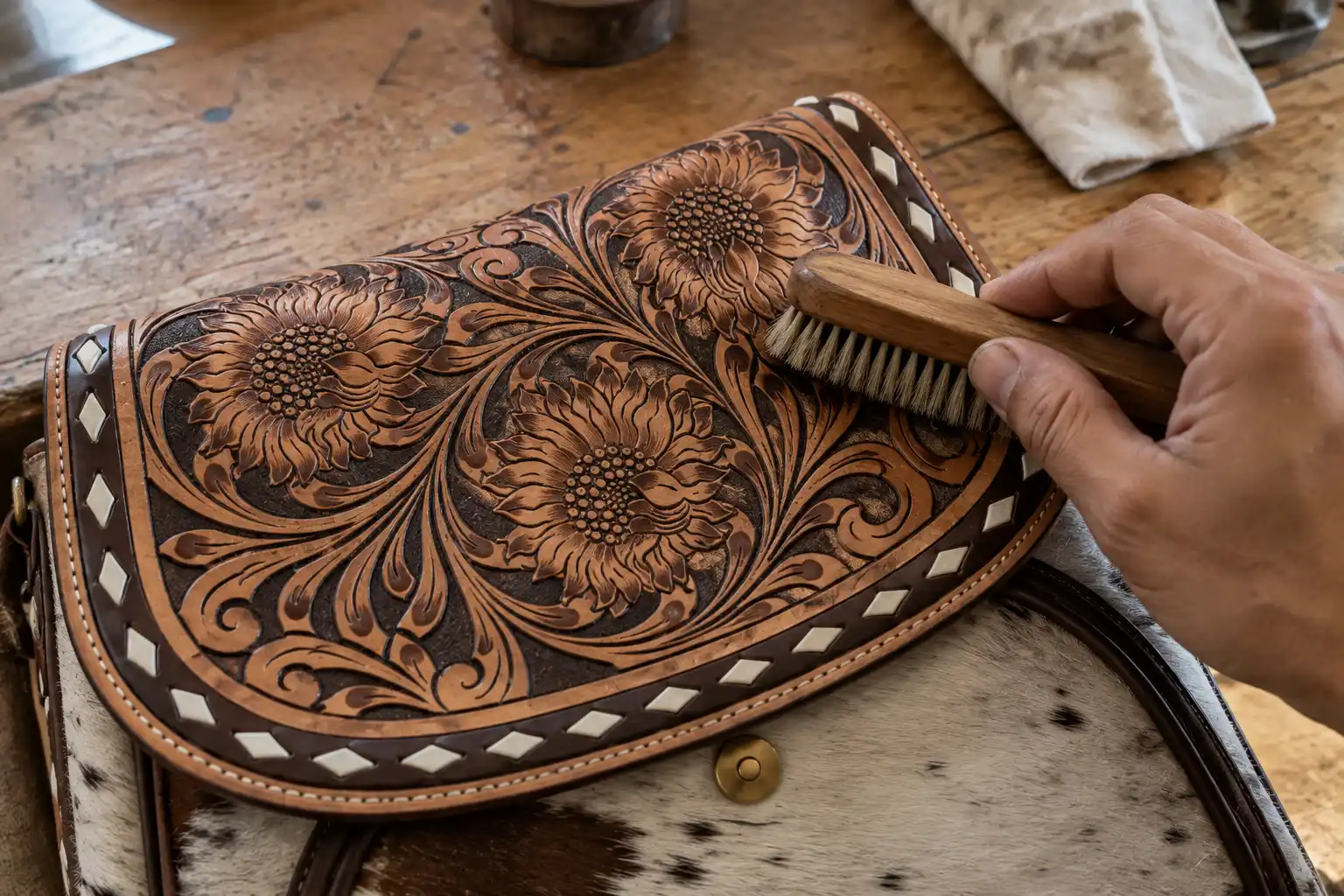
Brush the panel lightly with a soft brush, working with the carving and never pressing hard. Keep conditioner to a very small amount, because the excess settles in the grooves. Don’t put anything on top of or against the tooled side, and stand the bag upright so no weight rests on the carving. Water and direct sun are the two things to keep away from it.
Small variations in the carved lines are normal. A hand-cut design never repeats exactly, and good storage should keep those lines crisp rather than flatten them.
MAKER NOTE:Keep it somewhere cool and stable. Avoid radiators, heaters, hot cupboards, and places where temperature or humidity changes a lot.
Storing belts and wallets
The same rules apply to Aesthec belts and wallets: keep them dry, cool and out of direct sun, in a breathable cover rather than plastic. For belts, the CCI suggests that long leather pieces are stored horizontally to relieve stress, so a belt lying flat in a drawer is better than one hanging by the buckle.
Summary
To store a leather bag well, keep it dry, supported and able to breathe. Empty and brush it, let it dry fully, stuff it lightly, cover it in cotton and stand it upright somewhere cool and stable, then check on it every three months. If it’s hand-tooled, go light on conditioner and keep all weight off the carving.
Browse our handcrafted leather bags, or if you’ve just bought a backpack, read how to break in a leather backpack next.
Frequently asked questions
Can I hang a leather bag in a wardrobe?
It’s best not to. Hanging a bag by its handles puts the whole weight on the handles and stitching, and The Bridge says it compromises the structure over time. aunts & uncles adds that the handles can stretch and distort. Stand the bag upright in its dust bag on a shelf instead.
What can I use if I don’t have a dust bag?
A clean white cotton pillowcase works well, as The Bridge also suggests. Cotton lets air move around the leather while keeping dust and light off it. A clean cotton sheet laid loosely over the bag also does the job. Avoid sealed plastic bags and boxes, which can trap moisture against the leather.
Should I take the strap off before storing a leather bag?
If the strap is removable, detach it and store it flat inside the bag or beside it. If it’s fixed, stow it inside the bag so it doesn’t fold under the weight. Close the zips and fasten buckles only halfway, as The Bridge advises, so nothing strains the leather or the metal.
Can I put silica gel in a leather bag?
Leather makers disagree. The Bridge suggests an anti-humidity sachet inside the bag, while Tsuchiya Kaban warns that desiccants touching leather can damage it. If you try one, keep it wrapped and away from direct contact, and check with the maker first. The room matters most: the CCI’s target is 45 to 55% humidity.
Is a vacuum bag safe for leather?
No, we’d avoid it. The CCI says leather should be fully supported in storage, and a vacuum bag squashes the shape. Museums & Galleries NSW also says containers should not be airtight. Use a loose cotton cover and a little acid-free tissue inside instead.
How do I store a leather bag for several months?
Prepare it as usual, then wrap it in cotton fabric or acid-free tissue and keep it somewhere cool, dry and stable. Check it every three months, which is how often conservators inspect stored leather, and give it a few hours of fresh air each time. Damp is the real risk, since mould can start within about 10 days at 80% humidity.
Can I keep several leather bags on one shelf?
Yes, as long as each one has room. Pressure from a neighbouring bag can leave marks, and coloured leather can rub colour onto the bag beside it. Keep each bag in its own dust bag, leave a gap between them and don’t stack one on top of another.
Sources
- Canadian Conservation Institute: CCI Note 8/2, Care of Alum, Vegetable and Mineral-tanned Leather
- Canadian Conservation Institute: CCI Note 8/1, Removing Mould from Leather
- Museums & Galleries NSW: Preservation of historic leather, including saddlery
- The Bridge: Storing Leather Bags: Tricks to Keep Them Perfect
- aunts & uncles: The right way to store leather bags
- Tsuchiya Kaban: Leather Care Lesson 3, How to Store Leather Bags
Conservation guidance is written for museum objects, so we use it as a guide for storing everyday bags. The brand pages reflect each maker’s own advice and don’t always agree. Links checked October 2026.