What Is Hand-Tooled Leather? | Aesthec

What Is Hand-Tooled Leather? Inside the Craft Behind Every Aesthec Bag
Most people who ask “what is hand-tooled leather?” have already spotted the difference without knowing the name for it: a bag with a design that looks carved into the surface rather than printed on top of it, with edges that catch light differently depending on how deep the pattern runs. That’s tooling. Once you know what to look for, you stop mistaking it for embossing.
Embossing presses a pattern into leather using heat and a metal die, fast and identical every time. Tooling is slower and stubbornly manual. An artisan traces a design onto the leather’s surface, then carves and stamps it in by hand, one line and one impression at a time. The two can look similar in a product photo. They do not feel similar once you know the difference, and they certainly don’t come about the same way.
A technique that’s usually reserved for a different kind of leather
Most tooling guides will tell you the same thing: this craft is really only meant for vegetable-tanned leather, the kind tanned slowly with plant-based tannins that bulk up and lock the fibres in place, giving the hide a firm, structured feel that holds a carved line cleanly. Chrome-tanned leather, tanned quickly with chromium salts, is a different animal. The chrome cross-links the collagen fibres in a way that leaves them softer and more mobile, which is exactly why chrome-tan is prized for gloves, jackets, and soft-structured bags, and exactly why it has a reputation for not holding a tooled impression well. The fibres tend to spring back rather than stay put.
Aesthec’s bags use chrome-tanned leather. We’re not going to pretend otherwise, and we’re not going to pretend the craft is easy because of it. Every floral panel on pieces like The Nomad Teardrop or The Sunflower Flap is still carved and stamped by hand, on leather that isn’t supposed to make this easy. It takes a steadier hand, more careful moisture control, and a willingness to work against what the material would rather do. That’s the part of the process we think is worth explaining properly, rather than glossing over with a generic description of tooling that assumes vegetable-tan and leaves it at that.
The process, step by step
A single tooled panel, the flap of a bag, a wallet front, can take anywhere from a few hours to well over a day, depending on how detailed the design is. Here’s roughly what happens in that time.
Tracing. The design, usually a floral or scrollwork motif for Aesthec, gets transferred onto the leather’s surface, either from a stencil or freehand, using a stylus that leaves a faint line without cutting anything yet.
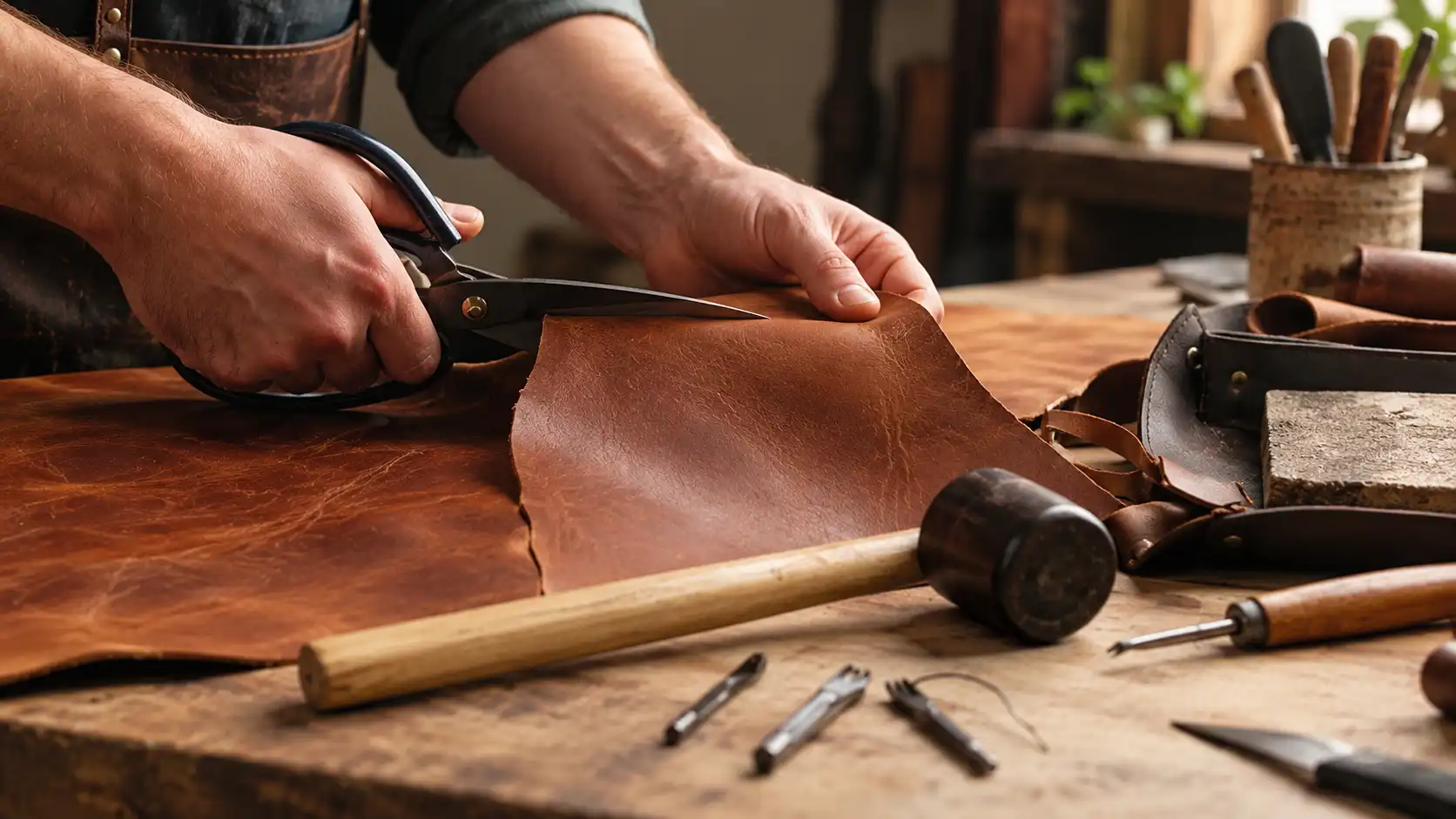
Carving. This is where the swivel knife comes in, and it’s the tool most people picture when they hear “leather carving.” Held upright and guided mostly with the fingers rather than the wrist, it cuts along the traced lines. Too shallow and the later stamping has nothing to grab. Too deep and you risk cutting through or distorting the surrounding leather, a real risk on a material that doesn’t hold a clean edge as readily as vegetable-tan does. The line has to stay smooth and continuous, because every hesitation shows, and there’s less margin for correcting a mistake afterward.
Stamping. Once the outline is cut, a set of individual metal stamps go to work: bevelers to push down the leather on one side of each cut and create the illusion of depth, pear shaders to add shading and movement to petals and leaves, seeders and backgrounders to fill flat space with texture instead of leaving it blank. Each one gets struck by hand with a rawhide mallet, not a metal hammer, which would crush the tool head over time. On leather that wants to spring back to its original shape, getting each stamp to hold requires firmer, more deliberate strikes and a practised sense of exactly how much pressure the material will actually keep.
Finishing. The piece is dyed and sealed to lock in colour and protect the surface, before edges are finished smooth. Only then does it get assembled into the finished bag.
None of this is decorative flourish for its own sake. Every stage exists because it’s the only way to get a mark that survives use, on a material that makes you work for it.
What this means for a bag you actually carry
A hand-tooled piece will soften and develop character with handling over time, and the raised parts of the design tend to catch a touch more wear and colour than the recessed lines, which if anything makes the pattern read more clearly over the years rather than less. Two bags carved from the same stencil will never be perfectly identical, because a hand-guided knife doesn’t repeat itself exactly. Small variations in line weight and depth are part of what makes it hand-tooled rather than machine-made, not a flaw to be corrected.
At Aesthec, this is the technique behind pieces like The Nomad Teardrop and The Sunflower Flap, both carved with floral tooling and finished with genuine hair-on cowhide panels, made by hand in the UK. You can see more of the technique across our hand-tooled leather collection, and read more about our approach to craft on our Craft page.
Further reading on leather tooling technique: Wikipedia, Leather carving.