
How to clean leather bags at home

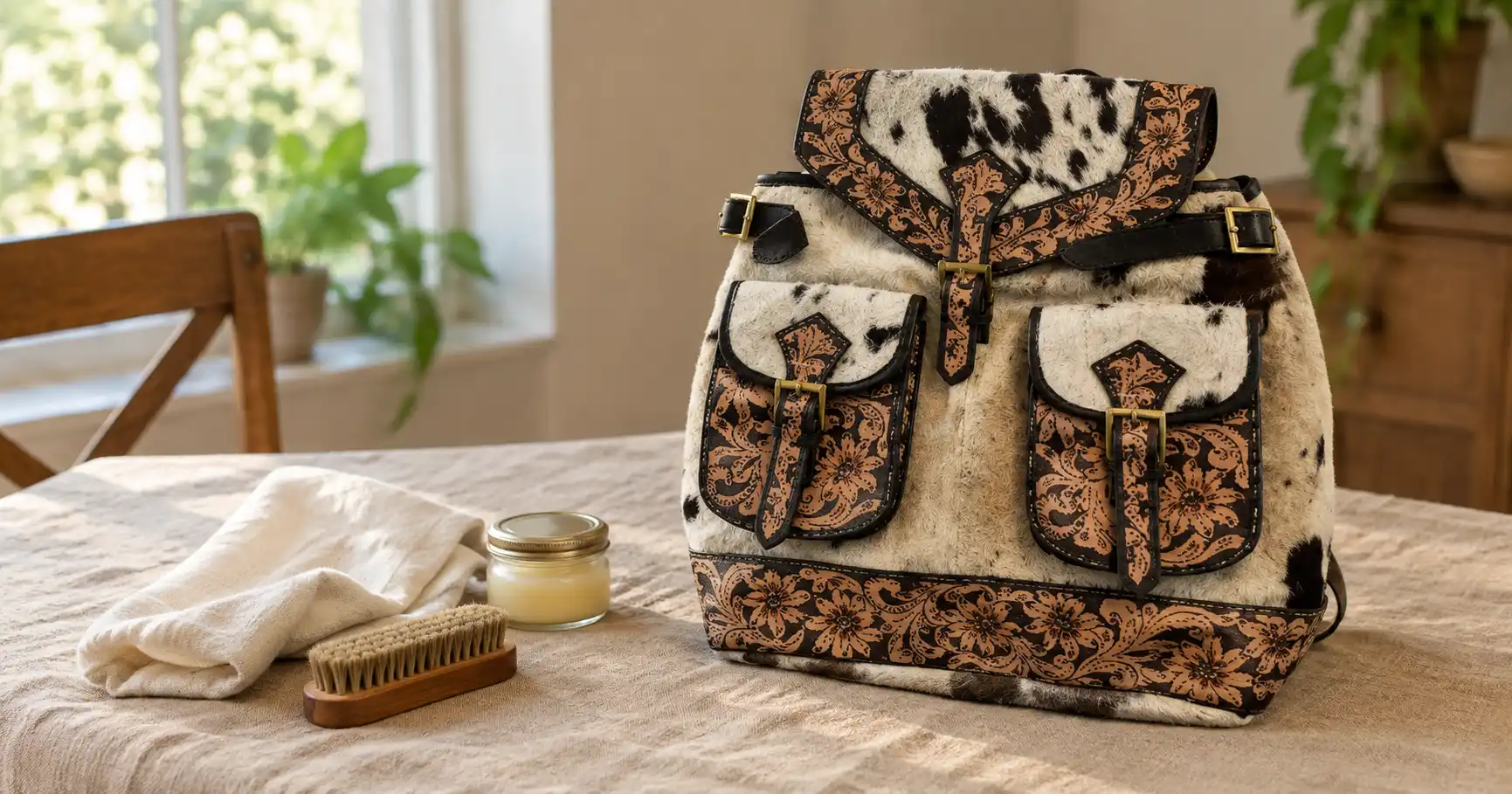
To clean a leather bag at home, empty it, dust it with a dry soft brush, then wipe each panel edge to edge with a barely damp cloth. Use a leather-specific cleaner only for real grime, air-dry away from heat and sun, and condition lightly. Skip alcohol wipes, saddle soap and hairdryers. Test everything on a hidden patch first.
Aesthec is a London-based handcrafted leather goods brand. Our bags, belts and wallets are made from full-grain leather, and our floral bags are hand-carved. A bag that is carried every day collects dust, hand oils, rain and the odd spill, and the cleaning advice online runs from sensible to damaging.
This guide sticks to what can be checked. We read conservation notes from the Canadian Conservation Institute and the US National Park Service, a Smithsonian record of a leather chemistry study, and care guides from UK leather makers. Each claim has its source beside it, and where the sources disagree we say so. Our leather is chrome-tanned, so a few points are written with that in mind. Suede and nubuck need a different routine and are not covered here.
What to check before you clean
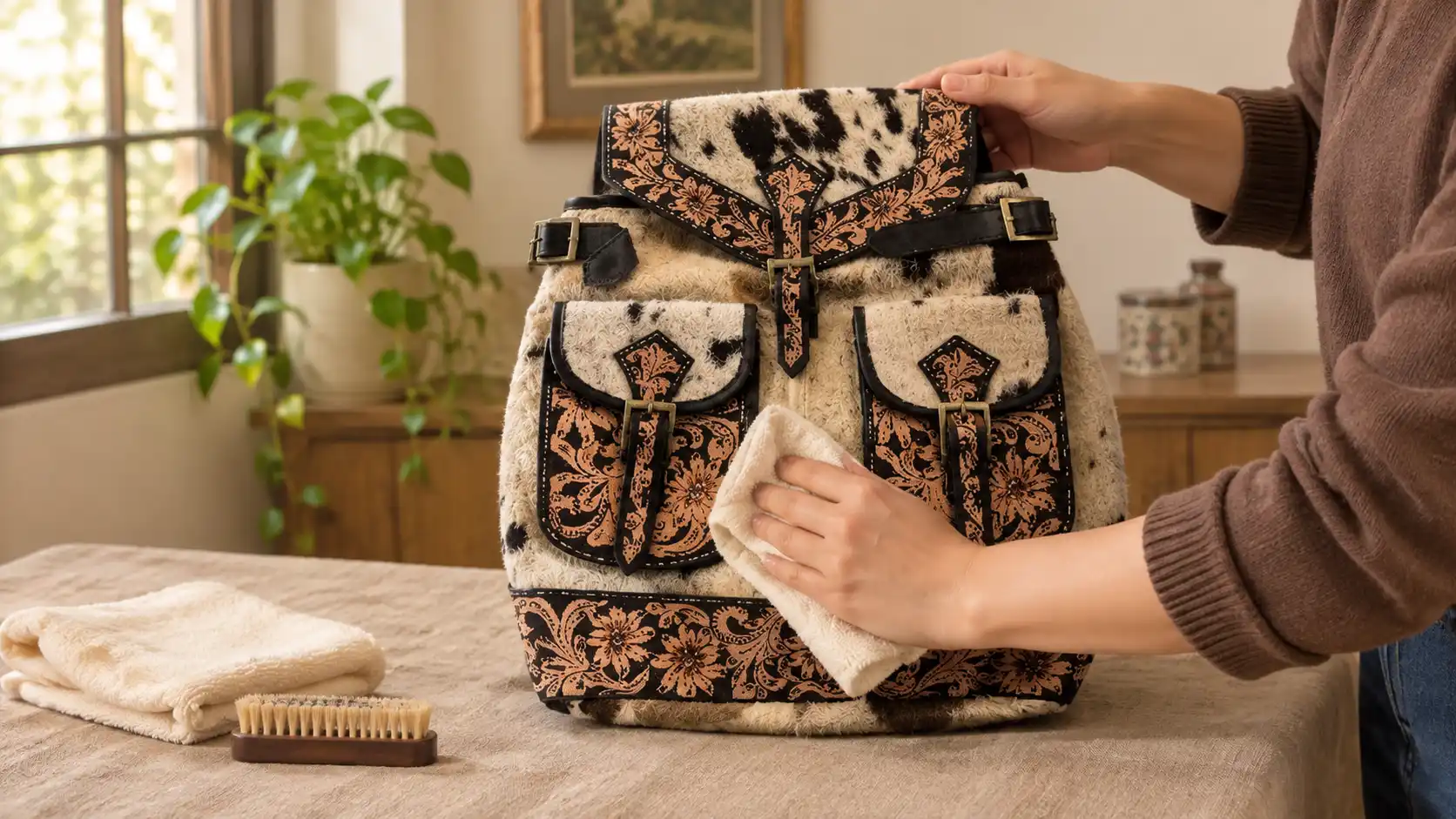
Read the care label first if the bag has one, then test every product on a hidden spot such as the underside of a strap. Cambridge Satchel suggests waiting ten minutes and checking for any change in colour before you carry on, and the Leather Repair Company gives the same advice.
Know what you are cleaning, because the finish decides the method. English bag maker Tusting suggests warm air from a hairdryer for its wax-dressed pull-up leathers, while Cambridge Satchel and Zatchels say never to use a hairdryer on their finished leathers. Both pieces of advice make sense for their own leather. That is why one rule for every bag does not work.
What you need
You need very little: two soft lint-free cloths, one for cleaning and one for drying, a soft-bristled brush, cotton buds for seams and hardware, a leather-specific cleaner and a leather conditioner. Cambridge Satchel says to avoid any cleaner that contains alcohol, acetone or bleach.
How to clean a leather bag at home, step by step
Step 1: Empty the bag and clean the inside
Take everything out, open every pocket and shake out the dust. The Leather Repair Company suggests vacuuming the interior. For a fabric lining, Cambridge Satchel recommends a well wrung cloth with warm water and a drop of mild soap, then leaving the bag open until it is fully dry before you move on.
Step 2: Dust the outside while it is dry
Use a soft brush or a dry cloth first. This step is not filler. The Canadian Conservation Institute (CCI) notes that dust attracts water vapour and can carry pollutants that harm leather. Zatchels, a Leicester bag maker, also tells customers not to skip it.
Step 3: Wipe each panel edge to edge
Dampen a clean cloth with plain water and wring it until it is only just damp. Wipe one whole panel from edge to edge instead of stopping in the middle. Cambridge Satchel and the Leather Repair Company make the same point: a half-cleaned panel leaves a tide mark where the clean area meets the dirty one. Tusting suggests water on a cloth or sponge first, adding a little gentle soap only if the surface needs more, then wiping over again with plain water.
Step 4: Use a leather cleaner only for real grime
Put a small amount of cleaner on the cloth, never straight onto the bag, and work in small circles, one section at a time. Zatchels advises a proper leather cleaner rather than homemade remedies. Keep the pressure light, because the Leather Repair Company warns that heavy rubbing can damage the surface.
Step 5: Dry it slowly
Let the bag dry at room temperature, away from radiators and direct sun. Cambridge Satchel warns that heat dries leather out fast and can cause cracking and warping. Conservation guidance agrees: CCI says that raised temperatures near a radiator speed up deterioration, and that dyed leather can be extremely light-sensitive, with damage that builds up and cannot be reversed.
Do not rush it into storage either. The Leather Repair Company recommends at least five days of air drying before the bag is put away, because damp patches can lead to mould.
Step 6: Clean the hardware
Wipe buckles and clasps with a soft dry cloth. For tarnish, dampen the cloth very slightly and keep products off the leather around the metal, as Cambridge Satchel advises. Dry the metal fully afterwards.
Step 7: Condition lightly
Once the bag is completely dry, apply a thin layer of conditioner with a soft cloth. Cambridge Satchel warns that too much can leave leather greasy or sticky, and Tusting says very oily products may darken leather permanently. Leave the conditioner to absorb, then buff gently with a clean dry cloth.
“Taking care of your leather bag doesn’t have to be complicated. A little gentle cleaning and regular care can keep it looking beautiful for years.”
Maker’s note
What not to put on a leather bag
Most damage comes from a product, not from dirt. The table sets out what the sources say and what we would do.
| Product | What the sources say | Verdict |
|---|---|---|
| Alcohol and hand sanitiser | In a demonstration on automotive leather, rubbing alcohol softened the surface and stripped the protective coat within seconds. UK makers also say to keep alcohol, acetone and bleach away. | Avoid. Blot any splash straight away. |
| Baby wipes and household wipes | Cambridge Satchel says they can strip the finish, darken the leather or leave a greasy residue. The Leather Repair Company also lists them as things to avoid. | Avoid. |
| Saddle soap | CCI says it is very alkaline, which degrades leather, and can leave a white scummy deposit. | Avoid on bags. |
| Soap and washing-up liquid | A leather glossary lists soap at pH 9 to 10 and says leather is made at around pH 4.5 to 5.5, so leather cleaners should not be alkaline. Tusting still uses a little gentle soap with a plain-water rinse. | A trace at most, and always rinse. Use a leather cleaner for anything beyond a wipe. |
| White vinegar | A conservation dictionary says chrome-tanned leather does not resist organic acids well. Cambridge Satchel and the Leather Repair Company both suggest diluted vinegar for ink. | The sources disagree. Try a leather-specific stain remover first and patch test. |
| Hairdryer or radiator | Cambridge Satchel and Zatchels both say no direct heat, and CCI says raised temperatures speed up deterioration. | Avoid. Air-dry. |
| Heavy oils and dressings | A National Park Service leaflet found dressings had little or no preservative effect and can discolour leather or leave it sticky. Tusting warns that very oily products may darken leather permanently. | Condition sparingly. |
One note on context. The CCI and National Park Service guidance is written for museum objects that are no longer used, so they can skip dressings altogether. A bag you carry needs to stay flexible, which is why UK makers still suggest light conditioning. Our reading of both is simple: less is better than more.
What chrome-tanned leather changes
Our leather is chrome-tanned, so we looked at how that tannage behaves. A bookbinding conservation dictionary hosted by the American Institute for Conservation describes chrome-tanned leather as very stable in water, able to withstand boiling water. The same entry says it does not resist perspiration or organic acids well.
A study by the British Leather Manufacturers’ Research Association, recorded by the Smithsonian Museum Conservation Institute, adds that in wear the perspiration absorbed by leather raises its pH. In that 15-week heated storage test, chrome leather lost no strength between pH 4 and 8, but strength losses rose sharply at lower pH. It is a laboratory result on leather samples, not a test of any particular bag, so treat it as direction rather than a guarantee.
Our reading is that plain water is not the main threat to a chrome-tanned bag. The bigger risks are sweat on handles and straps, household products that are too acidic or too alkaline, and uneven wetting that leaves tide marks. So wipe the parts your hands touch most, use a leather-specific cleaner instead of kitchen products, and clean panels edge to edge.
A small identification tip from CCI: chrome-tanned leather can sometimes be spotted by a blue-green line on a cut edge.
How to remove common stains
Act quickly and never rub. Rubbing pushes a stain deeper and spreads it. These steps come from two UK makers, and each row says which.
| Stain | What to do | Source |
|---|---|---|
| Liquid spill | Blot at once with a clean dry cloth. Then blot from the outside inwards with a cloth dampened in warm water. Dry in a warm room with no hairdryer or sun. | Zatchels, Cambridge Satchel |
| Grease or oil | Do not use water. Wipe off surface oil with a dry cloth, or leave cornstarch or baking soda on the mark overnight and brush it off. | Zatchels, Cambridge Satchel |
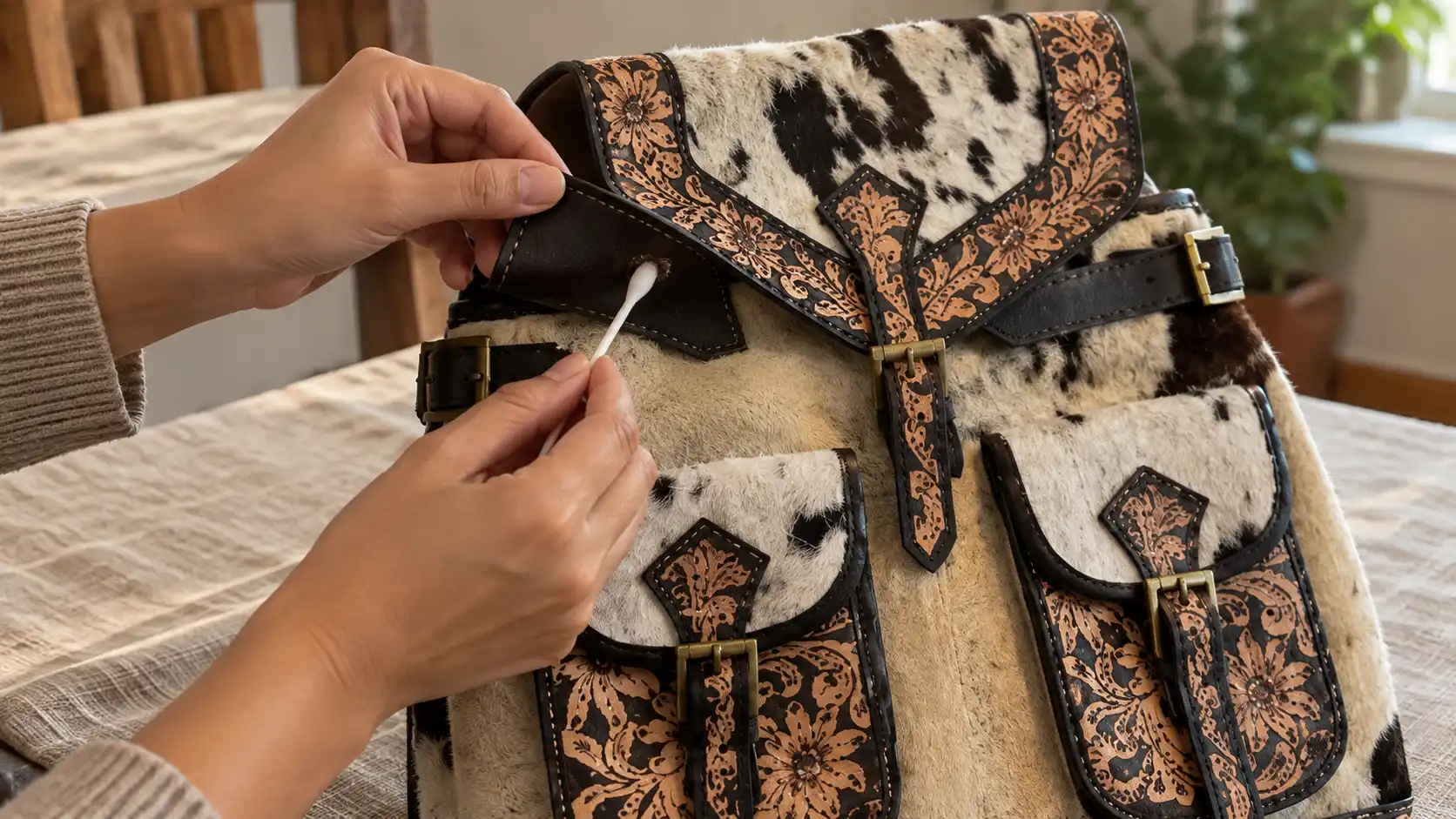
| Pen or ink | Dab, never rub. Use a leather stain remover, or a cotton bud with a little diluted white vinegar, working from the outside inwards. Patch test first. | Leather Repair Company, Cambridge Satchel |
| Water mark | Dampen the whole panel evenly and let it dry naturally, so the mark blends in instead of leaving an edge. | Cambridge Satchel, Tusting |
| Mud | Let it dry completely, brush off what you can, then clean the area with a damp cloth. | Cambridge Satchel |
| Dye transfer from dark denim | Work a leather cleaner on a cloth gently over the area. Prevention is better: keep new, unwashed dark denim away from light leather. | Cambridge Satchel |
If a stain has not shifted after one gentle attempt, stop. Cambridge Satchel says deep-set stains, heavy discolouration and mould that has taken hold are jobs for a professional leather cleaner.
Specific questions about cleaning a leather bag
Is the white film on my bag mould or product build-up?
It can be either. CCI warns that fatty blooms from dressings, soap from cleaners and salts from perspiration can resemble mould. The first two feel slightly waxy and the salts feel crystalline. Its separate mould note adds that oils and waxes can be mistaken for mould and says that if in doubt you should treat it as mould. Conservators test with a solvent swab and protective equipment, which is not a home job, so follow the mould steps below.
Why is there green residue around my brass fittings?
If your bag has brass hardware, this is a known reaction. CCI explains that copper alloys such as brass and bronze react with the oils in leather and form waxy green corrosion, called copper stearate, where metal touches leather. It is not dirt that a cleaner will lift. Keep the leather clean and dry and wipe the metal with a soft cloth, as Cambridge Satchel suggests. CCI says conservators shield the leather with a barrier strip while cleaning the metal, and that further stabilising is difficult and best left to an experienced conservator. If the green is spreading, take the bag to a leather repairer.
How do I clean a hand-carved or stamped bag?
Our floral bags are hand-carved and stamped, which leaves recesses where dust settles. A brush is the right tool. Cambridge Satchel says a soft-bristled brush lifts dust from textured leather without scratching, and the Leather Repair Company says a soft horsehair brush gets deep into the grain. CCI describes using a white vinyl eraser on ground-in dirt on smooth leather in good condition, but insists that every crumb be removed, especially near metal. That is hard to do inside carved detail, so a brush is the safer choice there.
Can I use hand sanitiser and then pick up my bag?
Let your hands dry first. The Motor1 report of a leather-trim specialist’s demonstration found that alcohol breaks down the protective top coat quickly, and the specialist’s advice was to let the alcohol evaporate before touching leather. The test used automotive leather, so read it as a guide to how alcohol attacks a finish rather than proof about every bag.
Can I stuff my bag with newspaper after cleaning?
No. Cambridge Satchel says newspaper ink can transfer to leather or lining and recommends tissue paper or bubble wrap. CCI’s handling advice also lists ink, pencil and newsprint as materials to keep away from leather, especially light colours. For the full routine, see our guide on how to store leather bags.
Do conditioners really protect leather?
Less than the marketing suggests. The National Park Service leaflet reviewed the research and found dressings had little or no preservative effect. It describes one bookbinding test that applied four dressings every two years for 34 years. The dressings gave some protection but did not prolong the life of the vegetable-tanned samples effectively, and results averaged slightly better for the chrome-tanned samples. Our reading: a light layer for flexibility on a bag you carry is reasonable, and heavy frequent oiling is not backed by the evidence.
What to do if you find mould
CCI’s mould note says mould needs relative humidity of 65% or more, plus warmth and poor airflow. It generally grows after two days at 90 to 100% humidity, ten days at 80% and 100 days at 70%. That is why a bag sealed away while still damp is a risk. CCI also warns that damp leather left sealed in a bag will grow mould.
For a small patch, CCI’s approach is this. Wear gloves and a close-fitting respirator (CCI names N95 or N100, which you will find sold as FFP2 in the UK). Dry the bag outdoors on a dry day, because mould smears if the leather is not dry enough to clean. Then vacuum very close to the surface, ideally with a HEPA-filter vacuum, going over it twice with the second pass at right angles to the first. A soft brush can guide stubborn mould towards the nozzle. Wash your hands afterwards, since some spores usually remain.
The CCI note does not recommend vinegar or alcohol on the leather. One leather-industry glossary, published with care-product brand Colourlock, does mention acetic acid for old leather with mould. With the organic acid warning for chrome-tanned leather above, we would leave that to a professional.
Mould is a health concern. CCI says people with allergies, breathing conditions or a suppressed immune system should not handle mouldy leather. If mould covers more than a small patch, or the smell is strong, take the bag to a professional.
How often to clean a leather bag
It depends on how often you carry it. For a bag used daily, Cambridge Satchel suggests a dry wipe weekly, a deeper clean every two to three months and conditioning every three to six months. Zatchels also says to clean a daily bag at least every two to three months. For a weekend or occasional bag, Zatchels suggests every six to nine months, and Cambridge Satchel suggests cleaning and conditioning before it goes into storage and again when it comes out. These are maker guidelines, not tested intervals. Clean sooner after a spill, and condition when the leather looks dull or feels dry.
The short version
Dust dry, wipe panel by panel with a barely damp cloth, use a leather-specific cleaner only when needed, dry away from heat and sun, and condition lightly. Keep alcohol, wipes and saddle soap away from the bag. When it goes back on the shelf, follow our guide on how to store leather bags. If your bag is hand-carved, read about hand-tooled leather on chrome-tan. Carrying a new backpack? See how to break in a leather backpack. You can also browse our leather bags, belts and wallets.
Frequently asked questions
How do you clean a leather bag at home?
Empty the bag and vacuum or wipe the lining. Dust the outside with a soft brush. Wipe each panel edge to edge with a barely damp cloth, using a leather-specific cleaner on the cloth for real grime. Air-dry away from heat and sun, then apply a thin layer of conditioner. Test everything on a hidden patch first.
Can you use baby wipes on a leather bag?
No. Cambridge Satchel says baby wipes can strip the finish, darken leather or leave a greasy residue, and the Leather Repair Company lists wipes and alcohol-based cleaners among things to avoid. Use a barely damp cloth, or a leather-specific cleaner on a cloth, instead.
Can you clean a leather bag with vinegar?
The sources disagree. Two UK leather makers use diluted white vinegar on ink marks, but a conservation dictionary says chrome-tanned leather does not resist organic acids well, and vinegar contains one. Try a leather-specific stain remover first and always patch test on a hidden spot.
How often should you clean a leather bag?
For a bag carried daily, UK makers suggest a deep clean every two to three months, with a quick dry wipe weekly. Occasional-use bags need cleaning every six to nine months. Condition every three to six months or when the leather looks dull. Clean sooner after a spill.
Is it mould or just a white film on my leather bag?
Oils, waxes, soap and perspiration salts can leave a white deposit that looks like mould. The Canadian Conservation Institute says that if in doubt you should treat it as mould: wear a respirator, dry the bag fully, then vacuum the surface with a soft brush.
How do you get pen off a leather bag?
Dab, never rub. Cambridge Satchel suggests a cotton bud with a little white vinegar, working from the outside of the mark inwards, and the Leather Repair Company suggests a dedicated leather stain remover. Test on a hidden spot first, and see a professional if the mark does not lift after one gentle try.
Can you dry a leather bag with a hairdryer or in the sun?
Not finished leather. Cambridge Satchel and Zatchels both warn against hairdryers and direct sun, and the Canadian Conservation Institute says dyed leather can be extremely light-sensitive, with damage that cannot be reversed. Blot with a dry cloth first, then air-dry at room temperature in a ventilated room, away from radiators.
Does conditioning leather actually help?
Less than the marketing suggests. A US National Park Service leaflet found dressings had little or no preservative effect, though flexibility matters on a bag you carry. A thin layer every few months is the usual maker advice. Heavy oiling can darken or stiffen leather.
Sources
Checked on 19 October 2026. Every page below was opened before it was cited. The conservation notes are written for museum collections, and the maker guides reflect each maker’s own leathers.
- Canadian Conservation Institute, CCI Notes 8/2: Care of Alum, Vegetable and Mineral-tanned Leather
- Canadian Conservation Institute, CCI Notes 8/1: Removing Mould from Leather (Janet Mason, revised 2016)
- National Park Service, Conserve O Gram 9/1: Leather Dressing: To Dress or Not to Dress (1993)
- Smithsonian Museum Conservation Institute record: Bowes and Raistrick, the effect of pH on the deterioration of vegetable, chrome, semichrome and chrome retan leathers
- American Institute for Conservation, CoOL: Etherington and Roberts, Bookbinding and the Conservation of Books, entry on chrome tanning
- Motor1: Coronavirus Cleanliness Could Be Damaging Your Steering Wheel
- The Leather Dictionary: pH value
- Cambridge Satchel: How to Clean a Leather Handbag (9 April 2026)
- Tusting: Looking After Your Leather Bag, Four Top Tips
- Zatchels: How To Clean A Leather Handbag (10 August 2021)
- Leather Repair Company: Leather Handbag Cleaning guide