How to Tell If a Leather Bag Is Real or Fake

How to Tell If a Leather Bag Is Real or Fake
Search “how to tell if leather is real” and you’ll find a solid set of tests: check the grain for natural irregularity, press it and see if it wrinkles like skin, check the cut edge for fibrous texture, smell it, sometimes even a water-drop test. All useful, all worth knowing. None of them answer the question that actually comes up with a bag like this one: the leather might be completely real, and the floral pattern carved into it might still not be hand-tooled at all. Those are two separate questions, and most guides only answer the first one.
Real leather can still be fake tooling
A pattern pressed into real, genuine leather with a heated metal die is called embossing, and it’s a completely legitimate, common technique, used everywhere from Western belts to structured handbags. The leather underneath is real. What isn’t real is the claim that a person carved it by hand, because nobody did. A die was pressed once, and now it presses the exact same pattern onto every single piece that passes under it.
The core difference: hand-tooling is carved and stamped by a person, one line at a time, so no two pieces come out identical. Embossing presses a fixed metal die into the leather, so every piece from that die looks exactly the same.
That single fact, repeatability, is the most reliable way to tell the two apart, more reliable than texture alone, because a well-made embossed pattern can genuinely feel three-dimensional and detailed to the touch.
What to actually check
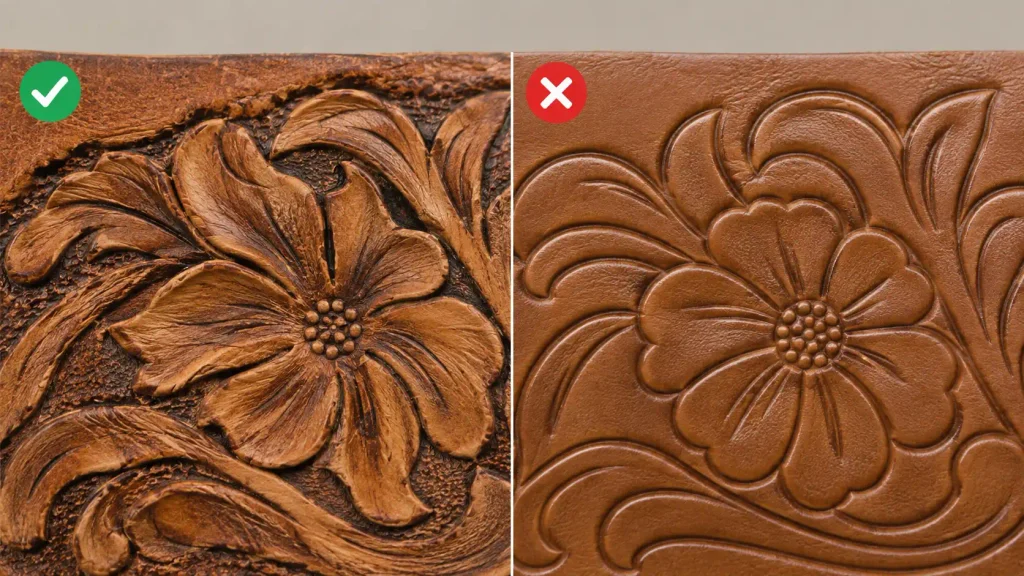
Doesn’t prove much on its own
Whether the pattern has visible depth or texture. A quality embossing die can produce real, tactile relief, this alone doesn’t confirm hand-tooling.
Actually tells you something
Compare the same design across two supposedly identical pieces. Hand-tooled work will show small differences in line weight and spacing. Embossed pieces from the same die will match exactly.
Look closely at the individual lines within the pattern too. A swivel knife cutting by hand produces a line with slightly varying depth and width along its length, it speeds up and slows down with the carver’s hand. A die-pressed line is uniform in depth and width for its entire run, because it was pressed once, all at once, not drawn.
The back of the panel is worth checking as well. Hand-tooling, because it’s carved and stamped from the front, sometimes leaves a very faint impression visible on the reverse side of the leather where the pattern was pressed hardest. A heat-embossed die, pressed under even pressure across a flat plate, tends to leave a flatter, more uniform reverse side.
What this means when you’re actually shopping
Quick reference
| Pattern looks identical on every unit in stock | Almost certainly embossed, not hand-tooled, regardless of how deep or detailed it looks. |
| Small variations between pieces of the same design | Consistent with genuine hand-tooling. |
| Line depth and width vary along a single carved line | Sign of a hand-guided tool, not a machine die. |
| A brand says “tooled” but shows no variation between pieces | Worth asking directly how the pattern is applied before buying. |
None of this makes embossed leather a bad product, it’s a real technique on real leather, and it’s usually more affordable for exactly that reason, a die is made once and reused indefinitely. The problem is only when embossing is sold using language that implies a hand-carved process. If a brand says hand-tooled, the honest test is simple: does this exact pattern look identical on every single piece, or does it not.
Every hand-tooled Aesthec piece, including The Artisan Voyager, The Nomad Teardrop, and The Sunflower Flap, is carved and stamped by hand, which is exactly why no two panels are ever quite the same. If you want the fuller explanation of the actual carving process and the tools involved, that’s covered in our piece on hand-tooled leather on chrome-tan.
Sources referenced on tooling and embossing technique: Wikipedia, Leather carving.