How to Break In a Leather Backpack | Aesthec

How to Break In a Leather Backpack (Without Damaging the Tooling)
Search "how to break in a leather backpack" and you'll get the same five methods everywhere: coconut oil, neatsfoot oil, a leather conditioner worked in with a cloth, some gentle flexing, and patience. Most of that advice is fine for plain, smooth full-grain leather. Almost none of it mentions what happens when the leather isn't smooth, when it's been carved into a floral pattern by hand and stamped with individual metal tools. That's a different piece of leather to break in, and treating it like a plain one is how you end up flattening the exact detail you paid for.
Why breaking in tooled leather is different
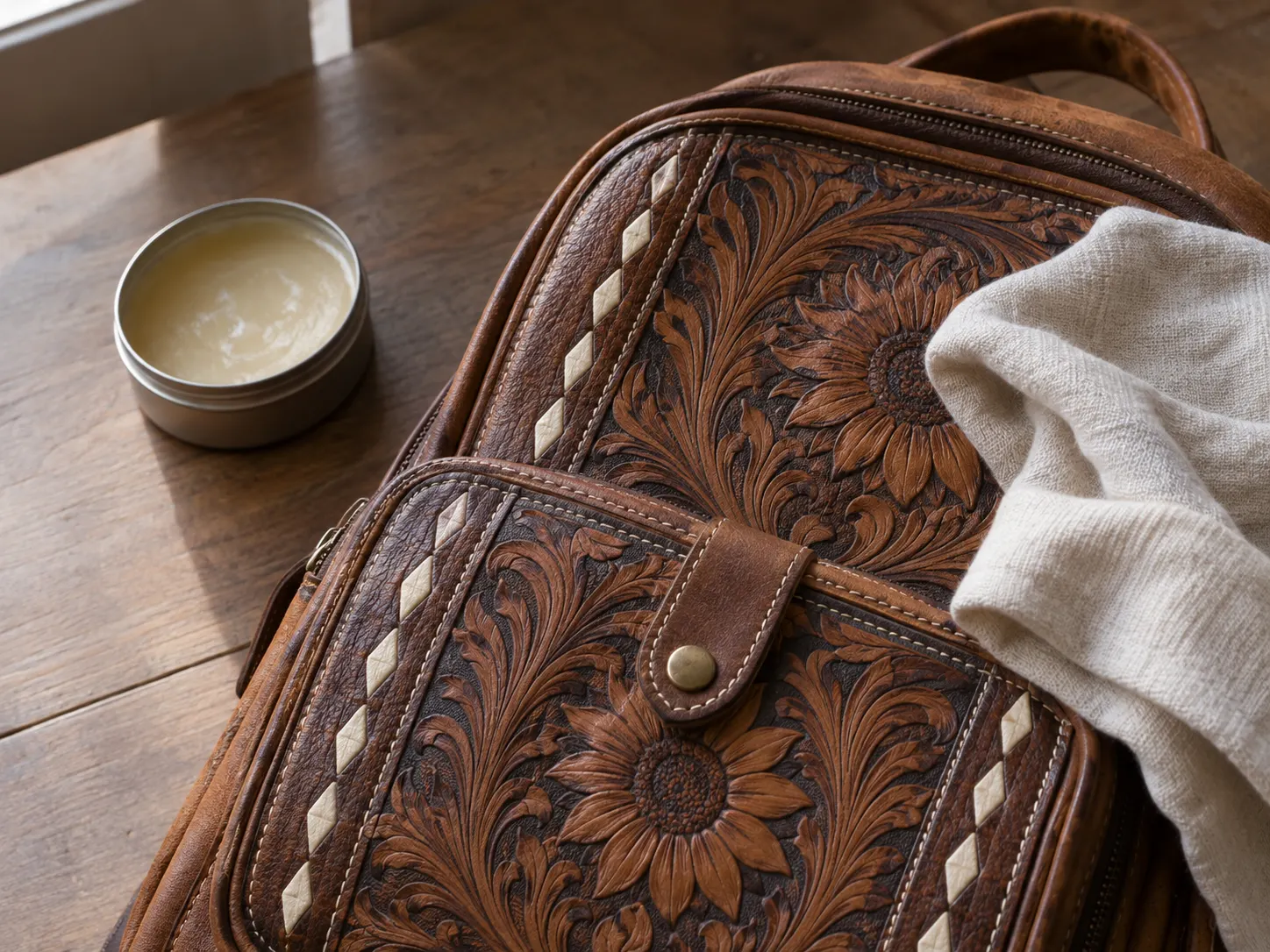
A hand-tooled panel isn't just decorated leather, it's leather whose fibers have been physically rearranged, carved along traced lines and pressed with stamps to create raised and recessed areas. That structure is the whole point.
The core rule: never press or flatten tooled areas, and apply conditioner sparingly. Too much softens the very structure the tooling depends on to hold its shape.
The grooves themselves are also a genuine trap for excess product. Heavy conditioner or oil worked into a smooth panel just absorbs. Worked into a carved floral pattern, it tends to sit in the low points and can cloud or dull the fine detail rather than soaking in cleanly.
How to soften a leather bag with tooling, step by step
Skip this
Heavy conditioner pressed directly into the carved lines, or aggressive hand-flexing on the tooled panels themselves.
Do this instead
A small amount of conditioner on a soft cloth, worked in wide circles, then left to absorb before deciding if a second light pass is needed.
Start with less than you think you need. Let it absorb fully before a second pass, most tooled leather needs far less product than a plain panel of the same size.
Skip the aggressive hand-flexing entirely on the tooled sections when you're trying to break in the backpack. The plain cowhide body can be handled the normal way, worn with a full load, gently bent at its natural fold points, but the carved panels don't need forcing. They'll soften at their own pace through ordinary use.
For dust in the grooves themselves, a soft, dry brush works better than a cloth. A cloth tends to skip over the recessed lines and only clean the raised surface, a brush gets into the carving without dragging product into it.
What's normal during the break-in period, and what isn't
Most general leather-care guides put a typical break-in period at somewhere around one to three weeks of regular use. Tooled leather doesn't really follow that clock in the same way, the carved pattern is already there regardless of how stiff the panel feels, so there's less pressure to rush the process, and no real benefit to trying.
Quick reference
| Some stiffness in week one | Normal. Eases with ordinary carrying, not with force. |
| Tooled lines look shallower after conditioning | Not normal. Usually means product sat in the grooves rather than absorbing. |
| Carved detail looks slightly hazy or clouded | Sign of over-conditioning. Stop and let the leather dry out before trying again. |
| Plain cowhide sections feel stiff | Normal for new full-grain leather. Softens fastest through actual use. |
If the tooled detail does look clouded, stop conditioning for a while and let the leather settle before trying again, adding more product on top of an already oversaturated panel rarely helps.
The short version
Breaking in a leather backpack with hand-tooled panels means less product, less force, and more patience than the standard advice suggests. Condition sparingly, dust with a brush instead of a cloth, let the plain leather sections soften through normal use, and leave the carved detail alone to do what it was built to do.
The hand-tooled panels on pieces like The Nomad Teardrop and The Sunflower Flap are carved the same way described here, by hand, one line at a time, so the same caution applies to both. If you want the fuller explanation of how the carving itself is done and why it holds up the way it does, that's covered in our piece on hand-tooled leather on chrome-tan.
Sources referenced on tooled leather care and structure: Wikipedia, Leather carving.